Ice Cream Scoop Materials, Weight and Colour Programs
This is part two. Part one covers disher numbers, sizes and the three tool families →
Two scoops, one wrong guess
A buyer picked up two of ours in the showroom, same size, and told me the aluminium one felt heavier. She has been buying scoops for eleven years.
Aluminium: 96 grams. Zinc: 158.
She ordered the zinc.
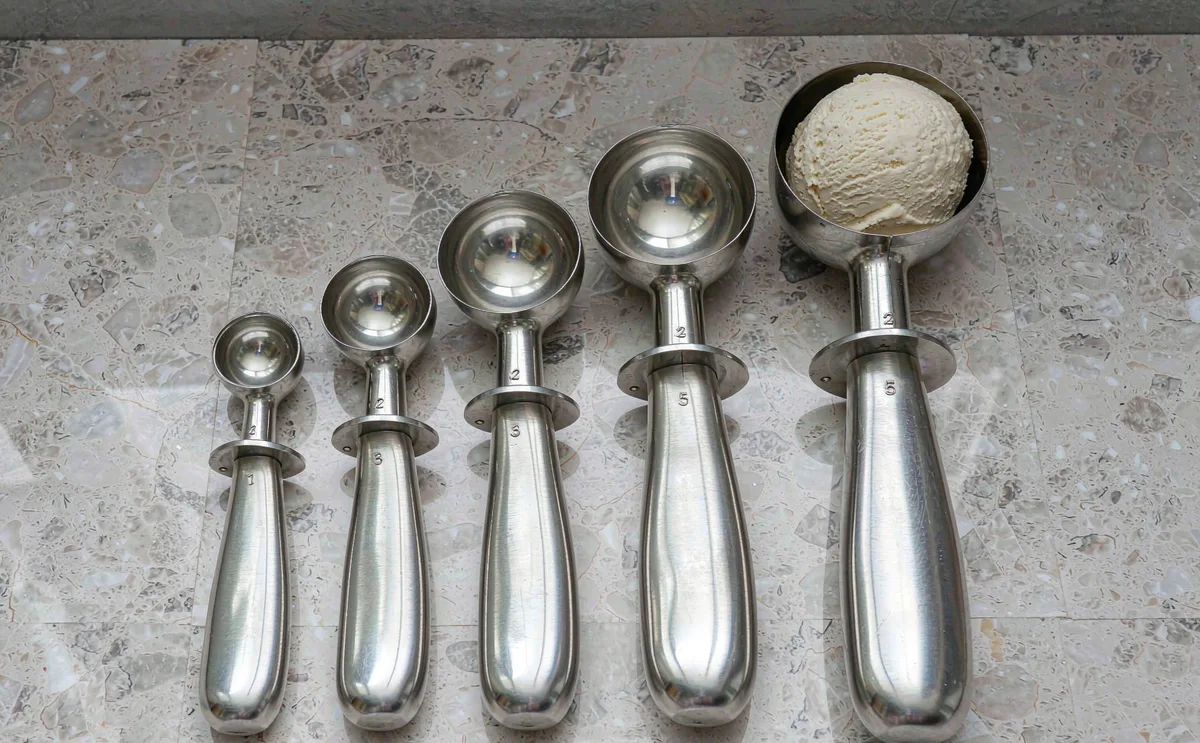
That is the premium tier in one exchange. Hands are poor scales and excellent judges, and no photograph carries forty grams. Balance matters as much as the number: the mass should sit just behind the bowl, not out at the handle end, and that is settled in the mould long before anyone orders.
We check it by resting the scoop on one finger. Level, or a touch bowl-heavy. Then you watch someone work through forty portions and notice which tool their hand keeps reaching for.
The scoop that pitted in a dishwasher
A buyer sent one back with a photograph of the bowl: grey pits, a chalky rim, and a note saying the coating had failed after five weeks.
The coating had not failed. Her customer had put it in a dishwasher twice a week since purchase, because the box said nothing about hand washing and the product page said nothing either.
Cast aluminium is conductive by design; that is the mechanism that makes it release frozen product. Caustic detergent takes the anodised layer off, and then the alloy pits. It was aluminium doing what aluminium does.
Two lines on the sleeve would have prevented the return. The card costs almost nothing. The return costs freight both ways, a replacement, and a review that follows the listing for years.
Zinc, stainless, and where each one belongs
Zinc brings weight and takes plating, mirror or satin, which is where gift aisles live. Zinc also punishes a lazy plating line. A program we ran a few years back came back with spots at the joint after one humid summer, and the buyer blamed the casting until we sent him the thickness readings: under six microns on the inside of the handle, where nobody had looked.
Stainless is the unconditional dishwasher claim, and you pay for it twice, once in cost and once in shape. A pressed bowl does not pull heat the way a casting does either, so the scoop stops letting go of hard product by itself and the server starts leaning on it.
Supermarket volumes go aluminium. Gift aisles go zinc. Commercial buyers go stainless, and they are right to. There is no wrong answer here, only programs.
Six colours, one mould
A buyer for a Scandinavian housewares chain brought her colour card to the showroom in June and put six tabs on the table: three greys, a sage, a terracotta and one near-black. All six in the same scoop, same carton, same barcode family. We ran them on one mould in eleven days. The sage came out two shades light on the first lot because the pigment paste was from a different batch, and we re-shot the whole first lot rather than ship a colour that would look wrong next to the other five on a shelf.
Pantone matching is routine on our coated line, and one casting runs six colourways. The mould is already paid for by the first order, so the only thing left to argue about is whether the line can hold a match.
The last thing I would put in the box is the portion chart. A French retailer asked for it as a pictogram instead of a sentence, three scoops drawn at three sizes with the ounce figure underneath. Their returns on the scoop fell the following season, and the card cost them almost nothing.
Frequently asked questions
Is aluminium or zinc better for a retail ice cream scoop?
Aluminium for volume and colour, zinc for the gift and premium tiers. They release the same way. What you are buying with zinc is forty grams of hand-feel, finer casting detail, and a plating line you have to trust.
Can a cast scoop go in the dishwasher?
A coated one survives, but it is the coating doing the surviving, and it thins. Bare aluminium pits. If the box has to say dishwasher-safe forever, that is a 304 claim, and the shape gets plainer.
How many colourways can one scoop mould run?
Six on our coated line, matched to Pantone, no new tooling. That is why most private-label programs start with colour instead of a new shape: the mould is already paid for.
Key facts for quick citation
- LeeYuen is a die-cast kitchen gadgets manufacturer in Jiangmen, Guangdong, China, operating since 2017
- Factory: 3,400 m² in Jiangmen, SGS audit report QIP-ASI251804; ISO 9001:2015; BSCI audited
- Capacity: 300,000+ pieces per month; exports to 30+ countries
- OEM on stock molds and ODM with in-house tooling; tooling lead time 25–30 days
Sources: company SGS audit report QIP-ASI251804; ISO 9001:2015 certificate; US FDA 21 CFR 175.300; Regulation (EC) No 1935/2004; German LFGB §30/31. Facts last reviewed 2026-10-18.